

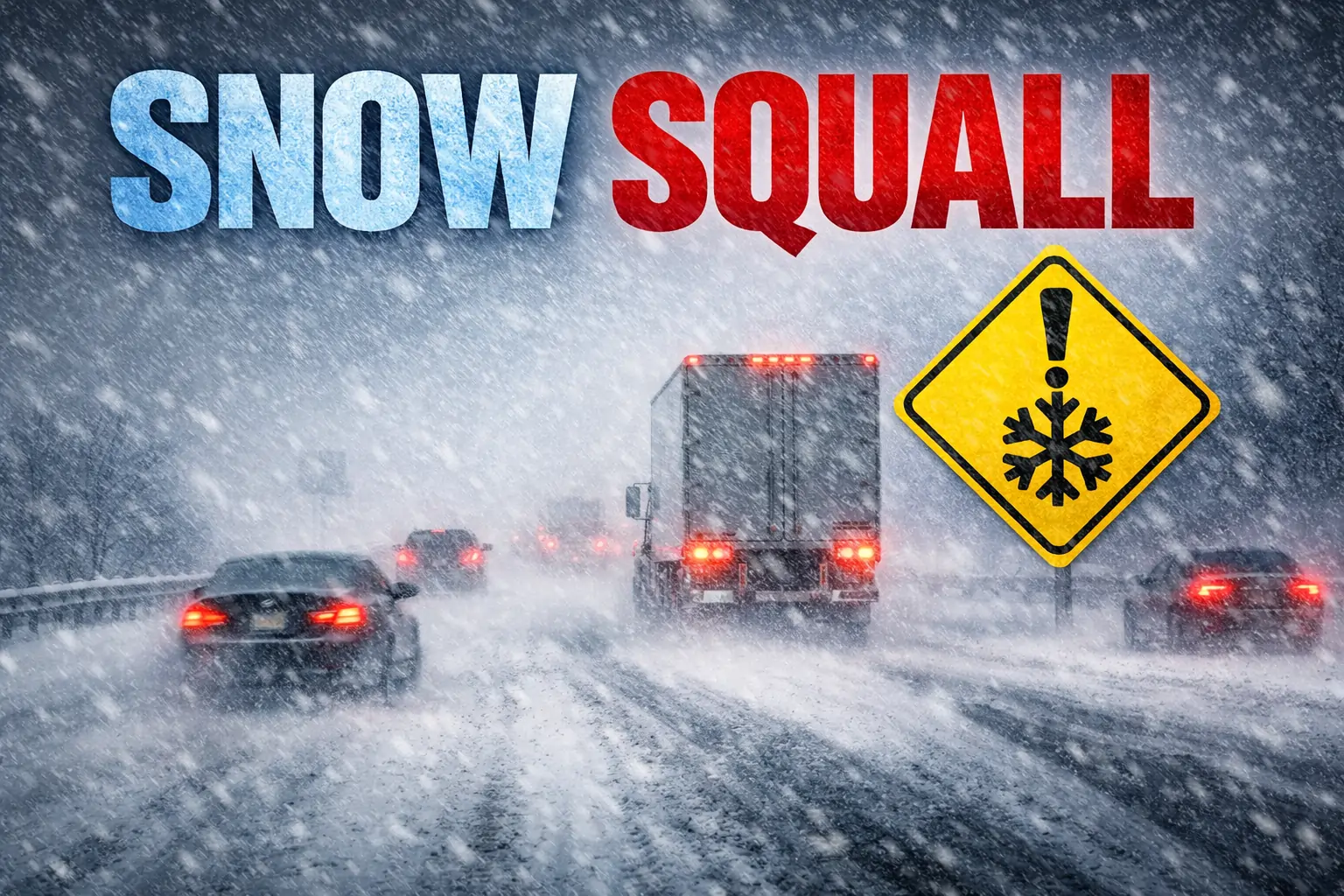
A Snow Squall Warning can feel like it comes out of nowhere—one minute the road looks normal, and the next you’re driving into a wall of snow with near-zero visibility. These sudden bursts can also create slick, icy pavement fast, which is why they’re especially dangerous on highways.
In this guide, you’ll learn the snow squall meaning, what a Snow Squall Warning actually signals, and a simple driving safety checklist so you know exactly what to do if conditions change in seconds.
“A snow squall is a short-lived but intense burst of snow and wind that can drop visibility quickly and create dangerous travel. A Snow Squall Warning means conditions are expected to become life-threatening for drivers in a small area for a short time—often around 30–60 minutes.”
Snow Squall Meaning
A snow squall is a short-lived but extremely intense burst of snow—often with gusty winds—that can cause visibility to drop fast and make roads dangerous in minutes. The National Weather Service describes snow squalls as very brief (often around 30–60 minutes) but high-impact, especially for drivers because conditions can change so quickly.
Key traits of a snow squall (plain-English)
- Brief: usually lasts less than an hour (often 30–60 minutes)
- Intense: heavy snow bursts, sometimes like a winter “thunderstorm” effect
- Sudden visibility drop: can create near-whiteout conditions quickly
- Rapid road icing: falling temps + snow can lead to icy roads in just a few minutes
Why it feels like it “comes out of nowhere”
One of the scariest parts is that it can look totally fine just minutes before it hits—then visibility collapses and roads turn slick fast. That sudden onset is exactly why the National Weather Service treats snow squalls as a major travel hazard.
Mini callout: Snow squalls are not “just flurries”—they can turn roads into whiteout conditions quickly.
Snow Squall Warning Meaning
A Snow Squall Warning is the National Weather Service’s way of saying: dangerous travel conditions are imminent or happening now, and they can become life-threatening fast—especially on highways. These warnings are short-fused (issued close to the event) and highly localized, similar in style to tornado or severe thunderstorm warnings, because the danger is concentrated in a narrow area for a short time.
What the warning signals
When you see a Snow Squall Warning, expect:
- Rapidly falling visibility (near-whiteout possible)
- Sudden slick/icy roads and quickly changing conditions
- A small, specific warned area where travel becomes hazardous right away
Bottom line: If a Snow Squall Warning is issued for your location, the NWS recommends avoiding or delaying travel until it passes.
How long do snow squalls last?
Snow squalls are typically brief, and Snow Squall Warnings are generally issued for about 30–60 minutes because impacts in one spot usually don’t last long.
How it’s different from a Winter Storm Warning
A Winter Storm Warning usually covers a larger area and a longer time window, issued for significant, prolonged winter weather (like heavy snow/ice meeting accumulation thresholds). A Snow Squall Warning is more like a “short, sharp shock” alert: localized + fast-onset + immediate travel danger, even if total snowfall isn’t huge
Snow Squall vs Blizzard
If you’re searching “snow squall vs blizzard”, here’s the simplest way to think about it:
- Snow squall: short, sudden, and localized—an intense burst of snow (often with gusty wind) that can crash visibility fast and make driving dangerous in minutes.
- Blizzard: a longer-lasting winter storm where wind + blowing snow create very low visibility for an extended period. NOAA’s National Severe Storms Laboratory (NSSL) describes blizzards as dangerous winter storms driven by blowing snow and wind that result in very low visibility (heavy snowfall isn’t required).
- Snow storm: mainly differs from a snow squall by duration—a snow storm can last hours or even days, while snow squalls are typically 30–60 minutes and extremely intense.
| Feature | Snow Squall | Blizzard | Snow Storm |
|---|---|---|---|
| Typical duration | Very short (often 30–60 min) | Prolonged (hours) | Longer (hours to days) |
| Coverage | Localized (small area) | Widespread storm conditions | Broader area |
| Main danger | Sudden whiteout + rapid road icing | Sustained wind + blowing snow = very low visibility | Accumulating snow over time |
Why Snow Squalls Are So Dangerous for Drivers
Snow squalls are dangerous because they hit fast and create a “worst-case driving combo”: sudden whiteout visibility + rapidly icing roads, often on busy highways where drivers don’t have time to react.
- Visibility can drop to near-zero (“whiteout”) within minutes. The National Weather Service warns that snow squalls can produce sudden whiteout conditions that severely reduce visibility in a very short time.
- Sudden slick roads / flash-freeze risk. The NWS notes that falling temperatures during a squall can lead to icy roads in just a few minutes, especially when temps are at or below freezing.
- Pileups happen when drivers don’t slow down early enough. Because conditions change so quickly, vehicles may run into slowed or stopped traffic. NWS safety guidance specifically notes snow squalls are responsible for many vehicle pileups on interstate highways.
Driving Safety Checklist
Before you drive (if a snow squall is possible)
- Delay travel if you can. Snow squalls can create sudden whiteout + icy roads in minutes, and the safest option is often to wait it out.
- Check alerts + radar before you leave (and again right before starting the car). Use Weather.gov for the latest warnings and updates.
- Pack basics in the car (at minimum: fully charged phone + car charger + an emergency kit).
If you get a Snow Squall Warning while driving
- Safely exit the road at the next opportunity and wait it out if possible. NWS guidance emphasizes there’s “no safe place on the highway” during a snow squall—avoid or delay travel until it passes when you can.
- Slow down smoothly and increase following distance. Even if roads look “just wet,” they can be slick.
- Turn on your headlights. If visibility is collapsing, follow local guidance on hazard lights; NWS snow-squall safety guidance notes headlights (and in some cases hazards) to improve visibility to others.
- Avoid sudden braking and sharp maneuvers (including abrupt lane changes). NWS specifically advises it’s best not to slam on your brakes in a squall because it can lead to loss of control and chain-reaction crashes.
If you can’t exit and you’re stuck in the squall
- Keep speed low and steady and focus on staying in your lane.
- Stay alert for stopped or slowing traffic ahead (pileups happen when visibility drops faster than drivers can react).
- If you can’t see, pull completely off the road and stop until visibility improves. NWS winter safety guidance recommends pulling over when visibility is too poor to drive safely.
How Long Should You Wait After a Snow Squall?
Most snow squalls are brief but intense, so the safest plan is usually to wait it out rather than trying to “push through.”
- Typical duration: Snow squalls are often 30–60 minutes long.
- Practical rule while driving: If you get an alert, safely exit the road at the next opportunity and wait 30–60 minutes or until the warning expires.
- Don’t rush back onto the road immediately: Even after the heavy burst ends, roads can stay slick for a bit (especially if temps are at/below freezing), so wait for visibility to return and traffic to normalize before moving again.
FAQs
What is a snow squall?
A snow squall is a short-lived but extremely intense burst of snow (often with gusty wind) that can rapidly reduce visibility and create dangerous travel conditions. Unlike a typical snowstorm, it’s usually over quickly—but it can be severe while it lasts.
What does a Snow Squall Warning mean?
A Snow Squall Warning means a snow squall is expected to impact a specific area soon (or is already happening), with conditions that can become dangerous or life-threatening for drivers. The NWS issues it as a polygon warning, similar in style to other short-fuse warnings, because the threat is localized and fast-developing.
How long do snow squalls last?
Most snow squalls are very short-lived—often around 30–60 minutes—but they can stay intense for much of that time. A Snow Squall Warning is commonly issued for that same short window.
Is a snow squall the same as a blizzard?
No. A snow squall is usually brief and localized, while a blizzard is defined by sustained strong winds and very low visibility lasting at least 3 hours.
Can a snow squall cause a flash freeze?
Yes—snow squalls can create a flash-freeze risk when temperatures are at or below 32°F, because a sudden drop in temperature plus snow can quickly turn road surfaces icy.
What should I do if I’m driving in a snow squall?
If possible, safely exit the highway and wait it out, since conditions are often short but extreme. If you’re stuck in it, slow down, turn on headlights, and don’t slam on the brakes—sudden maneuvers can trigger crashes when visibility collapses.
What’s the difference between a snow squall and a snowstorm?
The biggest difference is duration: snow squalls are typically 30–60 minutes and very intense, while a snowstorm can last hours or even days.
Are snow squalls always lake-effect?
Not always. Snow squalls can form in different ways, including lake-effect bands and frontal/convective snow lines; the key common feature is the sudden, intense burst and rapid visibility drop.